



About the Author
[Author] Wang Leyang -- Technical Application Specialist, SUN BANG TiO2
10+ years of hands-on experience in titanium dioxide technical application across coatings, plastics, rubber, and paper industries. Specializes in rutile and anatase TiO2 performance optimization, grade selection, and global compliance standards. Has supported procurement and technical teams across 20+ countries in selecting the right TiO2 products for their manufacturing processes.
LinkedIn: linkedin.com/company/zhongyuan-shengbang-xiamen-technology-co-ltd
Facebook: facebook.com/share/18Vsc4d4Wy
TL;DR -- Key Takeaways
> Titanium dioxide (TiO2) is the most widely used white pigment in the world because of its unmatched brightness, refractive index, and chemical stability.
> It is an essential raw material in coatings, plastics, rubber, paper, inks, and masterbatch -- industries that account for over 90% of global TiO2 consumption.
> TiO2 is produced via two industrial processes: the sulfate process and the chloride process, each yielding products with different characteristics suited to specific applications.
> Global TiO2 production exceeds 7 million tons per year, with China accounting for approximately 45% of total output as of 2026.
> For B2B buyers, understanding TiO2 grades, specifications, and application requirements is the first critical step in making informed purchasing decisions.
What Exactly Is Titanium Dioxide?
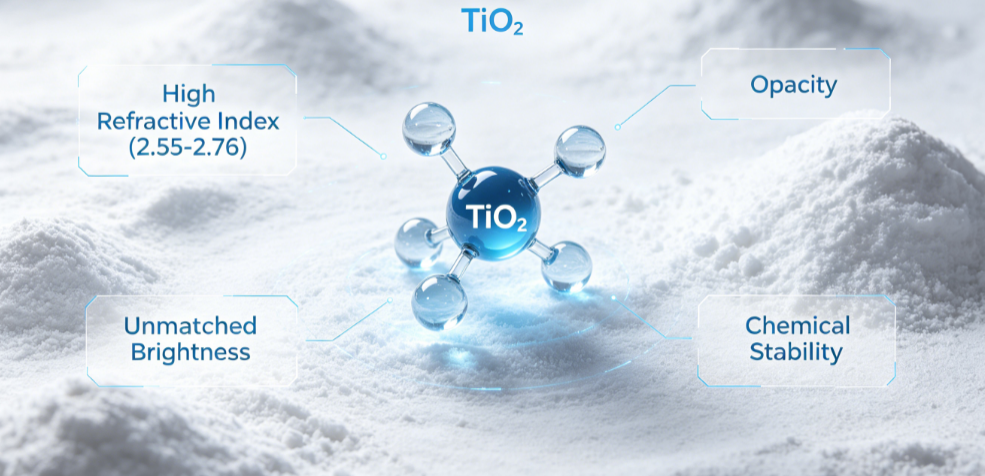
Titanium dioxide (TiO2) is an inorganic compound composed of titanium and oxygen that functions as the most effective white pigment available to modern industry. In simple terms, it is a fine white powder that, when incorporated into paints, plastics, paper, or any other material, provides exceptional whiteness, brightness, and opacity.
TiO2 achieves this because of its uniquely high refractive index -- ranging from 2.55 to 2.76 depending on the crystal form -- which is higher than any other white pigment. For comparison, zinc oxide has a refractive index of 2.0, calcium carbonate 1.6, and talc 1.57. This means TiO2 scatters visible light far more efficiently, which is why even a small amount dramatically improves covering power and brightness.
>> Answer Nugget: Titanium dioxide (TiO2) is an inorganic white pigment with the highest refractive index (2.55-2.76) among all white pigments, making it irreplaceable for providing whiteness, brightness, and opacity across coatings, plastics, paper, and other materials.
From a chemical standpoint, TiO2 is remarkably stable. It does not react with most acids, alkalis, or organic solvents under normal conditions. It is non-toxic, non-flammable, and resistant to UV degradation -- properties that make it safe for use in food-contact packaging, cosmetics, and even pharmaceutical tablets, in addition to its primary industrial applications.
The Two Crystal Forms: Rutile vs. Anatase
TiO2 exists naturally in three crystal structures, but only two are commercially significant: rutile and anatase. The difference between them is not merely academic -- it directly determines which grade your factory should order.
>> Answer Nugget: Rutile TiO2 has a higher refractive index (2.76), superior weathering resistance, and is the preferred choice for outdoor coatings, plastics, and high-durability applications. Anatase TiO2 has a slightly lower refractive index (2.55) but offers a softer white tone and is more cost-effective for indoor applications like paper and interior paints.
Rutile TiO2 accounts for roughly 85-90% of global TiO2 production by volume because its photostability makes it suitable for outdoor applications. In my 10 years working with coating manufacturers, I have consistently seen that projects specifying rutile grades for exterior architectural coatings experience significantly fewer color-fading complaints compared to projects that attempted to use anatase grades outdoors.
The key technical distinction lies in the photocatalytic activity: anatase TiO2 is approximately 10 times more photoactive than rutile, which means it generates more free radicals when exposed to UV light -- these radicals attack the organic binder in paints and plastics, causing chalking, gloss loss, and color fading. This is precisely why anatase grades are formulated with additional surface treatments when used in any application with incidental UV exposure.
Where Is Titanium Dioxide Used? Six Core Industries
>> Answer Nugget: Titanium dioxide is used in six core industries -- coatings (35% of global demand), plastics (25%), paper (12%), inks (5%), rubber, and masterbatch -- with the remaining volume going into specialty applications like cosmetics, food, and pharmaceuticals.
1. Coatings and Paints (35% of Global TiO2 Demand)
The coatings industry is by far the largest consumer of TiO2. In a typical architectural paint formulation, TiO2 comprises 15-25% of the total formula weight and accounts for roughly 40-50% of the raw material cost. This is because TiO2 delivers the hiding power and whiteness that paint buyers judge with their eyes.
According to data from the American Coatings Association, the global paint and coatings market consumed approximately 2.6 million metric tons of TiO2 in 2025. In my factory visits to coating manufacturers in India and Turkey, I have observed that even paint producers using entry-level formulations will not compromise on TiO2 quality -- because a poor TiO2 grade means applying three coats instead of two, which doubles labor cost and time for their customers.
2. Plastics and Masterbatch (25% of Global TiO2 Demand)
In the plastics industry, TiO2 serves a dual purpose: it provides the bright white color that consumers expect from products like PVC pipes, window profiles, and packaging films, and it also protects the polymer matrix from UV degradation. TiO2 absorbs UV radiation and dissipates it as harmless heat, which significantly extends the service life of outdoor plastic products.
For masterbatch producers, TiO2 loading levels typically range from 50-70% by weight, which means the dispersibility, flowability, and thermal stability of the TiO2 grade directly determine production efficiency. A TiO2 grade with poor dispersibility can cause screen pack clogging, surface defects, and inconsistent coloring -- problems that can cost a masterbatch producer thousands of dollars per day in downtime.
3. Papermaking (12% of Global TiO2 Demand)
In the paper industry, TiO2 is used primarily in high-end decorative paper, laminate paper, and bible paper where maximum opacity at minimum thickness is required. TiO2 delivers 10 times the opacity of calcium carbonate at the same loading level, which allows papermakers to produce thinner, lighter paper without sacrificing print-through resistance.
4. Printing Inks, Rubber, and Specialty Applications
In the printing ink industry, TiO2 serves as the white base pigment in flexographic and gravure inks for flexible packaging. Because ink film thickness is far thinner than paint film -- typically 1-5 microns versus 50-100 microns -- the TiO2 grade used in inks must have exceptionally fine and uniform particle size distribution to achieve adequate opacity at such low film weights.
In the rubber industry, TiO2 is used as a white pigment and reinforcing filler in products such as white-wall tires, shoe soles, and rubber flooring. Anatase grades are often preferred in rubber applications where the slightly softer white tone is aesthetically desirable and extreme weather resistance is not the primary requirement.
How Is Titanium Dioxide Manufactured?
>> Answer Nugget: TiO2 is manufactured via two industrial processes -- the sulfate process (using ilmenite ore and sulfuric acid, producing both rutile and anatase grades) and the chloride process (using high-grade rutile or synthetic rutile with chlorine gas, producing only rutile grades with higher purity and tighter particle size control).
The sulfate process, which accounts for roughly 40% of global production, starts with ilmenite (FeTiO3) digested in concentrated sulfuric acid. This process is more flexible -- it can use lower-grade ores and produce either rutile or anatase products depending on the calcination conditions. However, it generates more waste byproducts, particularly iron sulfate, which must be managed through recycling or disposal.
The chloride process, accounting for approximately 60% of global TiO2 output, starts with high-grade rutile or upgraded ilmenite reacted with chlorine gas at high temperature (900-1,000 C) to produce TiCl4, which is then oxidized to produce high-purity TiO2. The chloride process yields a product with tighter particle size distribution and generally higher brightness, but requires more expensive feedstock and sophisticated process control.
At SUN BANG, we maintain relationships with producers using both technologies, which allows us to recommend the most cost-effective and technically suitable product for each customer's specific application rather than being locked into one process.
The Global TiO2 Market: Why This Matters for Your Business
>> Answer Nugget: Global TiO2 production exceeded 7.3 million metric tons in 2025, with China producing approximately 45% of the total. TiO2 is considered a barometer of industrial activity because its consumption correlates directly with coatings, construction, and manufacturing output.
According to the Titanium Dioxide Manufacturers Association (TDMA), global TiO2 demand has grown at a compound annual growth rate (CAGR) of approximately 3.5-4.0% over the past decade, driven primarily by urbanization in developing economies. Every new apartment building, every new car, and every new appliance requires TiO2 somewhere in its supply chain.
For B2B buyers, understanding the TiO2 market dynamics is essential for procurement planning. Prices are influenced by three primary factors: feedstock availability (ilmenite and rutile mining output), energy costs (both sulfate and chloride processes are energy-intensive), and seasonal demand patterns (Q1-Q2 peaks for coatings, Q3-Q4 strength in plastics and masterbatch).
What Specifications Should Buyers Check?
>> Answer Nugget: The five essential parameters every TiO2 buyer should verify are: TiO2 content (typically >=92% for rutile), brightness (Hunter L value >=94), tint strength or reducing power (relative to a standard), oil absorption (indicating dispersibility, typically 15-25 g/100g), and particle size distribution (median particle size ~0.25-0.30 um for optimal light scattering).
In my experience working with procurement teams, the most common mistake first-time TiO2 buyers make is comparing only the unit price per ton without understanding these specification differences. A TiO2 product priced $200/T lower may require 15-20% higher loading levels to achieve the same hiding power, which means the effective cost per square meter of finished product can actually be higher with the cheaper raw material.
Frequently Asked Questions About Titanium Dioxide
Q: Is titanium dioxide safe for use in consumer products?
A: Titanium dioxide is classified as generally recognized as safe (GRAS) by the U.S. FDA for use in food, cosmetics, and pharmaceuticals. In 2022, the European Commission proposed a ban on TiO2 as a food additive (E171), which took effect in August 2022, but this specifically applies to food-grade TiO2 used as a colorant -- not to industrial TiO2 used in paints, plastics, or paper. Industrial TiO2 grades are regulated under REACH (EC 1907/2006) and remain fully compliant for their intended uses. SUN BANG supplies all products with full REACH, RoHS, and SGS documentation.
Q: What is the minimum order quantity (MOQ) for TiO2?
A: At SUN BANG, the standard MOQ starts at 1 metric ton, with competitive pricing available for container-load (20-28 MT) and bulk orders. We also offer sample quantities (1-5 kg) free of charge for first-time technical evaluation before committing to commercial orders.
Q: How should TiO2 be stored to maintain quality?
A: TiO2 should be stored in a cool, dry environment in its original sealed packaging. Exposure to moisture can cause agglomeration, which negatively affects dispersibility. Under proper storage conditions (temperature below 40 C, relative humidity below 60%), unopened TiO2 has a shelf life of at least 24 months without measurable quality degradation.
Q: What is the typical delivery time for TiO2 from China?
A: For standard rutile and anatase grades, SUN BANG maintains inventory at our 7 warehousing centers across China, enabling dispatch within 7-15 days of order confirmation. Sea freight transit times vary by destination: 15-20 days to Southeast Asia, 25-30 days to the Middle East and India, 30-35 days to Europe via the Suez Canal, and 40-45 days to Brazil.
Post time: Jun-02-2026


