



Introduction
When a coatings chemist examines a titanium dioxide supplier’s specification sheet, the first question is always the same: “Will this grade give me the hiding power I need?”
Hiding power — or opacity — is the single most important performance attribute of titanium dioxide in most applications. It determines how much pigment you need to achieve complete coverage, which directly impacts your formulation cost and final product quality.
But not all specifications listed on a Certificate of Analysis (CoA) are equally relevant to hiding power. This article breaks down the four technical parameters that matter most: particle size, particle size distribution, refractive index, and TiO₂ content. Understanding these will help technical buyers and R&D professionals read supplier quality reports with confidence and select the optimal grade for their application.
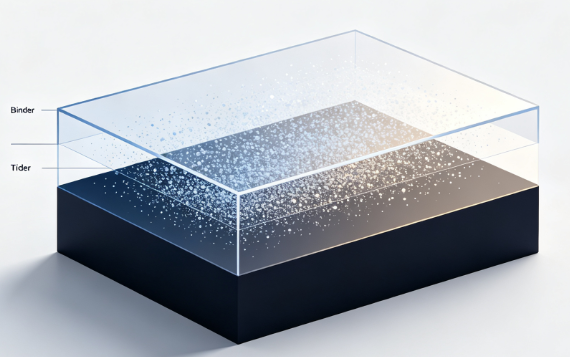
1. Particle Size: The Foundation of Light Scattering
The hiding power of titanium dioxide depends fundamentally on its ability to scatter visible light. And light scattering efficiency is governed by particle size — specifically, the relationship between particle diameter and the wavelength of light being scattered.
Why Particle Size Matters
Mie scattering theory tells us that maximum light scattering occurs when the particle diameter is approximately one-half the wavelength of the incident light. For visible light (400–700 nm), the optimal TiO₂ particle size is in the range of 200–300 nm — typically 220–280 nm for rutile grades.
When particles are too small (below 150 nm), they enter the Rayleigh scattering regime, where scattering efficiency drops sharply. The pigment becomes translucent and contributes more to transparency than opacity — useful for certain specialty applications but detrimental for hiding power.
When particles are too large (above 350 nm), scattering efficiency also declines because the particle begins to act as a discrete inclusion rather than an efficient scatterer. Large particles also hurt gloss and can cause surface roughness in film applications.
What to Look for on a CoA
Quality titanium dioxide suppliers report mean particle size on their CoAs. Here is what different values mean:
|
Mean Particle Size |
Hiding Power Impact |
Typical Application |
| 200–250 nm |
Excellent hiding power |
Architectural coatings, industrial paints |
| 250–300 nm |
Good hiding, better blue tone |
Masterbatch, plastic extrusion |
| 300–350 nm |
Moderate hiding, coarse texture |
Paper, rubber, low-cost applications |
2. Particle Size Distribution: Consistency Is Key
Mean particle size alone does not tell the full story. Two batches of TiO₂ can have the same mean particle size but entirely different particle size distributions (PSD), leading to dramatically different hiding power performance.
Narrow vs. Broad Distribution
A narrow PSD means most particles fall within a tight range around the mean. This is desirable for hiding power because it means nearly all particles are contributing to light scattering at near-optimal efficiency.
A broad PSD contains a significant fraction of very small and very large particles. The oversize fraction contributes little to hiding power but can reduce gloss, while the undersize fraction is essentially wasted — it consumes raw material cost without delivering opacity.
Key PSD Indicators
When reviewing a CoA, look for these particle size distribution metrics:
- D10, D50, D90 values: The particle size below which 10%, 50%, and 90% of the sample falls. A D90/D10 ratio close to 3 or lower indicates a narrow distribution.
- Span: Calculated as (D90 − D10) / D50. A span of 0.8–1.2 is typical for high-performance pigment grades. Values above 1.5 suggest excessive variation.
- Uniformity: Some suppliers report a uniformity coefficient. Lower values indicate more uniform particle size.
[Image: Comparison of narrow vs. broad PSD curves for two TiO₂ batches with same D50 but different hiding power]
3. Refractive Index: The Physics Behind Opacity
Refractive index (RI) is the fundamental physical property that makes titanium dioxide the world’s premier white pigment. It measures how much light bends when passing from one medium (e.g., the binder resin) into another (the TiO₂ particle). The greater the difference in refractive index between the pigment and the surrounding medium, the more light is scattered — and the higher the hiding power.
Comparing Refractive Indices
This table shows why TiO₂ is in a league of its own:
|
Pigment / Filler |
Refractive Index |
Relative Opacity |
| Rutile TiO₂ |
2.70–2.80 |
100 (reference) |
| Anatase TiO₂ |
2.50–2.55 |
~80–85 |
| Zinc Oxide (ZnO) |
2.02–2.03 |
~30–40 |
| Calcium Carbonate (CaCO₃) |
1.58–1.66 |
~10–15 |
| Talc (Mg₃Si₄O₁₀(OH)₂) |
1.54–1.59 |
Very low |
Rutile TiO₂ has the highest refractive index of any commercially available white pigment. This is why replacing TiO₂ with extenders always results in a significant hiding power penalty — no extender comes close to matching its light-scattering ability.
What to Check on a CoA
While most CoAs do not directly report refractive index (it is an intrinsic material property rather than a batch-specific test), the choice between rutile and anatase is the primary determinant. Rutile grades (RI 2.70+) will always provide superior hiding power to anatase grades (RI 2.50–2.55). For maximum opacity in coatings and plastics, always specify rutile TiO₂.
4. TiO₂ Content: Purity Drives Performance
TiO₂ content is the most straightforward specification on any CoA — and one of the most important. It tells you the percentage of actual titanium dioxide in the pigment powder. The rest consists of surface treatment coatings (e.g., alumina, silica, zirconia) and trace impurities.
How Surface Treatments Affect Hiding Power
Higher TiO₂ content does not automatically mean better hiding power. In fact, premium weather-resistant grades often contain 91–94% TiO₂, while general-purpose grades may reach 96–98%. The difference is surface treatment.
Surface treatments serve multiple purposes:
- Alumina (Al₂O₃) coating: Improves dispersibility in water-based and solvent-based systems. Also provides some durability enhancement.
- Silica (SiO₂) coating: Forms a dense barrier layer that prevents photocatalytic degradation. Essential for outdoor durability but slightly reduces hiding power because it creates a lower-RI layer around the particle.
- Zirconia (ZrO₂) coating: Offers excellent durability with minimal impact on hiding power. Typically used in premium grades for automotive and coil coatings.
The practical takeaway: a grade with 93% TiO₂ content and optimal surface treatment can outperform a 97% grade with poor surface treatment in real-world applications. The surface treatment directly affects dispersibility, and a poorly dispersed pigment — regardless of its TiO₂ content — will not achieve its theoretical hiding power.
Typical TiO₂ Content by Application
|
Application |
Typical TiO₂ Content |
Surface Treatment |
| Interior architectural coatings |
94–98% |
Alumina + organic |
| Exterior / weather-resistant |
91–95% |
Silica + alumina + zirconia |
| Masterbatch / plastics |
94–98% |
Alumina + organic siloxane |
5. How These Parameters Work Together
In practice, hiding power is the combined result of all four parameters operating simultaneously. A pigment with perfect particle size but low TiO₂ content will underperform. A pigment with high purity but the wrong particle size distribution will also disappoint.
Here is a practical checklist for evaluating a TiO₂ specification sheet:
1. Start with TiO₂ content — confirm it meets your application minimum (typically ≥93% for most industrial uses).
2. Check the crystalline phase — rutile for hiding power, anatase only if specific application requirements dictate.
3. Review mean particle size — target 220–280 nm for optimal scattering.
4. Evaluate PSD span or D90/D10 ratio — narrow distribution means more efficient pigment use.
5. Consider the surface treatment type — match it to your resin system and durability requirements.
6. Common Misconceptions About Hiding Power Specs
Myth: Higher TiO₂ Content Always Means Better Hiding Power
Not accurate. A 98% TiO₂ grade with poor dispersion due to inadequate surface treatment will hide less effectively than a well-dispersed 93% grade. Dispersion quality can override purity in real-world performance.
Myth: Finer Particles Give Better Hiding Power
This is only true down to the optimal size range (200–300 nm). Below that, Rayleigh scattering dominates and hiding power drops sharply. The finest TiO₂ grades (specially treated for high tint strength) sacrifice hiding power deliberately.
Myth: All Rutile Grades Deliver the Same Hiding Power
Rutile provides the highest potential, but actual hiding power varies significantly between grades due to differences in particle size control, PSD narrowness, and surface treatment chemistry.
[Image: Bar chart comparing refractive index of rutile TiO₂, anatase TiO₂, ZnO, CaCO₃, and talc]
Conclusion
Hiding power is not determined by a single specification. It is the product of four interdependent technical parameters: particle size, particle size distribution, refractive index (crystalline phase), and TiO₂ content with its associated surface treatment.
For technical buyers and formulation chemists, the ability to read a CoA with these parameters in mind is essential for cost-effective pigment selection. A thorough understanding of these specifications enables you to optimize formulations — avoiding both over-specification (paying for unnecessary purity) and under-specification (sacrificing hiding power to save cost).
When evaluating suppliers, always request full CoAs showing not just TiO₂ content, but also particle size distribution data and surface treatment details. Reputable manufacturers like SUN BANG provide comprehensive specifications across their rutile product range (BR and BCR series) to help you make informed technical decisions.
Post time: Jul-07-2026


