



Introduction
Paints and coatings consume approximately 55–60% of the world’s titanium dioxide production — more than every other application combined. For coating manufacturers and B2B buyers, selecting the right TiO₂ grade is not just a matter of technical preference; it is a significant economic decision that directly affects formulation cost, product quality, and market competitiveness.
The challenge is that not all TiO₂ grades perform equally across different coating systems. A pigment that delivers excellent hiding power in a solvent-based alkyd may fail to disperse in a water-based acrylic. A grade optimized for interior flat paints may chalk prematurely in exterior high-gloss enamels.
This guide provides coating formulators and procurement professionals with a systematic framework for selecting TiO₂ grades across different paint and coating applications. We cover the critical parameters — from surface treatment chemistry to resin compatibility — that determine real-world performance in architectural, industrial, automotive, and specialty coatings.
1. Why TiO₂ Is Indispensable in Coatings
Titanium dioxide delivers three essential functions in paint and coating formulations:
1. Opacity: Its high refractive index (2.70–2.80 for rutile) scatters visible light efficiently, providing the hiding power that allows thin coating films to completely cover the substrate.
2. Whiteness: TiO₂ absorbs almost no visible light, reflecting all wavelengths nearly equally. This produces the clean white base that is essential for tinted paints and white enamels.
3. Brightness stabilization: Unlike organic white pigments, TiO₂ is photochemically stable (when properly surface-treated) and does not yellow or fade under prolonged UV exposure.
No other commercially available white pigment or extender comes close to matching TiO₂’s combination of these three properties. Replacing TiO₂ with extenders like CaCO₃ or talc always results in a steep hiding power penalty — typically requiring a 6–10× increase in loading to achieve equivalent opacity.
[Image: Chart showing relative hiding power of rutile TiO₂ vs. anatase TiO₂ vs. common extenders (CaCO₃, talc, ZnO, BaSO₄)]
2. Understanding TiO₂ Grade Categories for Coatings
TiO₂ for coatings is broadly categorized by crystalline phase, surface treatment, and target application. The table below summarizes the main grade categories:
|
Grade Type |
TiO₂ Content |
Surface Treatment |
Best For |
| General-purpose rutile |
94–97% |
Alumina + organic | Interior architectural, general industrial |
| Weather-resistant rutile |
91–95% |
Silica + alumina + zirconia | Exterior architectural, automotive OEM |
| High-dispersion rutile |
94–96% |
Alumina + organic (optimized) | High-gloss enamels, coil coatings |
| Anatase |
96–99% |
None or minimal | Interior flat paints, low-cost formulations |
| Chloride-process rutile |
95–98% |
Alumina + organic | Premium architectural, automotive refinish |
Rutile vs. Anatase: The First Decision
The first question every coating buyer must answer is: rutile or anatase?
For virtually all exterior and most interior coating applications, rutile TiO₂ is the correct choice. Its higher refractive index (2.70 vs. 2.55) provides approximately 20–30% more hiding power per unit weight, and the rutile crystal lattice is inherently more photostable.
Anatase TiO₂ is used primarily in applications where cost sensitivity outweighs performance: low-cost interior flat paints, certain paper coatings, and specialty applications where photocatalytic activity is desired. For professional-grade coatings, rutile is the standard.
[Image: Side-by-side comparison of rutile vs. anatase coated panels after 500 hours QUV accelerated weathering test]
3. How Surface Treatment Determines Coating Performance
The inorganic and organic surface treatments applied during TiO₂ manufacturing are the most important differentiation between grades — and the most overlooked by buyers. These coatings, typically 3–8% of the total pigment weight, directly control:
- • Dispersibility — how quickly and thoroughly the pigment integrates into the coating vehicle
- • Durability — resistance to chalking, gloss loss, and color shift under UV exposure
- • Gloss development — the maximum gloss achievable in high-gloss formulations
Inorganic Coatings
|
Coating Type |
Function |
Coating Application |
| Alumina (Al₂O₃) | Improves wetting in polar systems; provides moderate durability enhancement | All general-purpose grades; water- and solvent-based systems |
| Silica (SiO₂) | Dense barrier against UV-triggered photocatalysis; essential for outdoor use | Exterior coatings; may slightly reduce gloss potential |
| Zirconia (ZrO₂) | Excellent durability with minimal hiding power loss; high cost | Automotive OEM, coil coatings, premium weather-resistant grades |
| Mixed (Al₂O₃+SiO₂+ZrO₂) | Combined benefits: good dispersion + high durability | Premium exterior grades; best overall balance |
Organic Surface Treatments
In addition to inorganic coatings, most premium TiO₂ grades receive an organic surface treatment (typically 0.1–0.5% by weight). These organic modifiers include polyols, siloxanes, and alkanolamines. Their function is to:
- • Reduce the surface energy of the pigment particle for faster wetting in the resin system
- • Improve compatibility with the specific binder chemistry (polar vs. non-polar)
- • Prevent re-agglomeration after milling by providing steric stabilization
The choice of organic treatment should match the coating vehicle. Polyol treatments work well in alkyd and polyester systems; siloxane treatments are preferred for acrylic and polyurethane coatings.
[Image: Cross-section diagram of a TiO₂ particle showing inorganic coating layers (alumina/silica/zirconia) and outer organic surface modifier]
4. Coating Type Selection Guide
Architectural Coatings (Decorative Paints)
Architectural coatings account for roughly 50% of all TiO₂ used in the paint industry. Selection criteria vary significantly between interior and exterior applications:
|
Parameter |
Interior Paints |
Exterior Paints |
| Recommended grade | General-purpose rutile (94–97% TiO₂) | Weather-resistant rutile (91–95% TiO₂) |
| Key requirement | High hiding power, good dry hiding | Chalking resistance, gloss retention |
| Surface treatment | Alumina + organic; moderate coating level | Silica + alumina; dense coating (3–8%) |
| PVC consideration | 15–25% for eggshell; 12–18% for semi-gloss | 18–25%; maintain binder-to-pigment ratio for durability |
| Typical loading | 15–25% of total formulation weight | 18–22%; lower loading if combined with extenders |
For interior paints, the buyer’s priority should be TiO₂ grades with optimized particle size (220–260 nm) and good dry hiding performance. For exterior paints, chalking resistance and gloss retention are paramount — accept the slightly lower TiO₂ content (higher treatment level) of weather-resistant grades.
Industrial Coatings
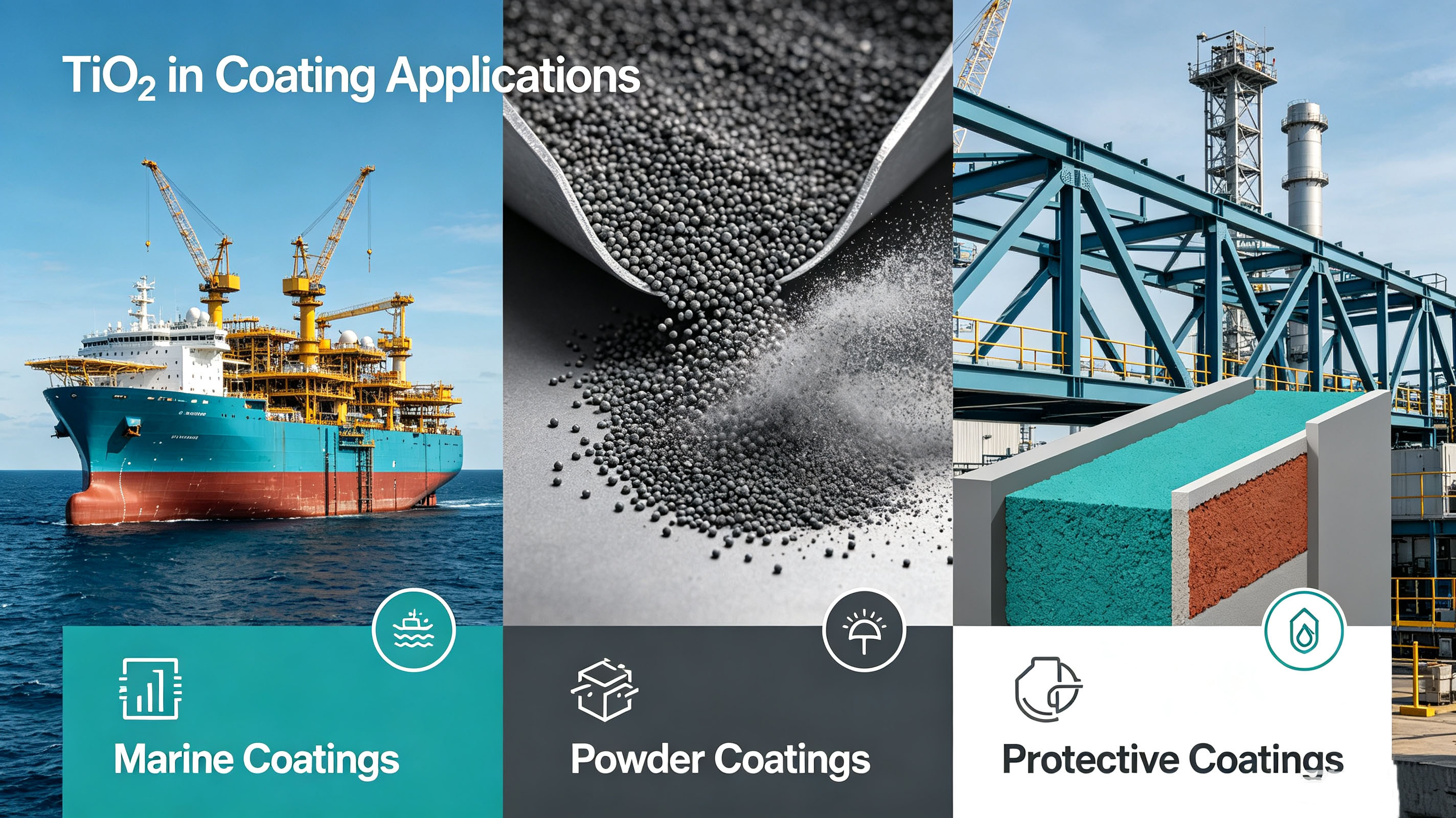
Industrial coatings — including maintenance, marine, protective, and powder coatings — require TiO₂ grades that can withstand harsh environments while maintaining consistent appearance. Key selection criteria:
- • High chemical resistance: silica or zirconia coatings preferred for acid/alkali exposure
- • Thermal stability: important for powder coatings cured at 180–220°C; chloride-process grades often preferred
- • Consistency: industrial coating batches are larger; tight PSD control ensures uniform color across batches
[Image: Application examples of TiO₂ in various industrial coating systems: marine, powder coating, protective coating]
Automotive Coatings
Automotive finishes are the most demanding coating application for TiO₂. The requirements include:
- • Ultimate weather resistance: minimum 5–10 years of exterior durability without chalking or yellowing
- • Excellent gloss: the initial gloss (20°) must exceed 85 units for OEM clear-over-base systems
- • Low yellowing: especially important for white and light-metallic OEM finishes
- • High dispersion fineness: any agglomerate larger than 10 µm will be visible as a defect
For automotive coatings, the recommended TiO₂ grades are premium chloride-process rutile grades with zirconia-containing surface treatments (TiO₂ content typically 91–94%). These grades command a premium price but are essential for meeting OEM performance specifications.
Coil Coatings
Coil coating — continuous application of paint to metal strip — subjects TiO₂ to extreme forming operations. The pigment must withstand:
- • Severe bending (T-bend tests down to 0T or 1T) without cracking
- • Short-duration, high-temperature curing (240–280°C peak metal temperature)
- • Outdoor exposure for building cladding and roofing applications (10–25 year warranties)
Recommended grades: high-durability rutile with silica + alumina dense coating, PSD optimized for minimal oversize particles.
[Image: Illustration of coil coating process flow with callouts showing where TiO₂ performance matters: mixing, curing, forming]
5. Formulation Optimization: Getting the Most from Your TiO₂
Critical Volume Concentration (PVC)
The pigment volume concentration (PVC) is the most important parameter in coating formulation. As PVC increases, opacity improves — but only up to the critical pigment volume concentration (CPVC). Beyond CPVC, the binder no longer fully fills the voids between pigment particles, and the film becomes porous. This causes a sharp decline in gloss, scrub resistance, and weather resistance.
For TiO₂ in most coating systems:
- • Below CPVC: hiding power increases linearly with TiO₂ loading
- • At CPVC: maximum opacity efficiency per unit of TiO₂
- • Above CPVC: hiding power may still increase marginally, but film integrity degrades rapidly
Experienced formulators operate at 80–95% of CPVC to balance opacity against film durability. The exact target depends on the gloss level required.
TiO₂ Loading Optimization
Typical TiO₂ loadings across coating types:
|
Coating Type |
TiO₂ (wt% of total) |
Typical PVC |
| Flat interior latex |
10–15% |
18–28% |
| Eggshell / satin |
15–20% |
15–22% |
| Semi-gloss / gloss |
18–25% |
12–18% |
| High-gloss enamel |
20–28% |
10–15% |
| Industrial / protective |
12–20% |
14–20% |
| Powder coating |
15–25% |
12–18% |
Extender Pigment Strategy
Using extenders (CaCO₃, talc, BaSO₄, SiO₂) alongside TiO₂ is standard practice in coating formulation. The key is to use extenders strategically:
- • Replace TiO₂ partially, not fully: extenders contribute negligible hiding power (RI 1.5–1.7)
- • Use fine-particle extenders: calcined kaolin and fine CaCO₃ (1–2 µm) can improve TiO₂ spacing to enhance light scattering efficiency
- • Monitor CPVC: every extender addition changes the overall PVC and shifts the CPVC
Well-optimized formulations often achieve 80–90% of the hiding power of a full-TiO₂ system at 60–70% of the TiO₂ cost by using 5–15% extender by weight.
[Image: Graph showing hiding power vs. TiO₂ loading at different PVC levels, with the CPVC inflection point clearly marked]
6. Evaluating TiO₂ Suppliers for Coatings
When assessing potential TiO₂ suppliers for coating applications, request and review these specific documents:
4. Full Certificate of Analysis (CoA): Verify TiO₂ content, particle size (D50, D90), pH, oil absorption, and residue on sieve (45 µm).
5. Surface treatment details: Understand the inorganic coating type and level. A supplier that cannot disclose this likely lacks quality control over the coating process.
6. Weathering data: For exterior-grade TiO₂, request QUV or xenon-arc accelerated weathering results showing gloss retention and color shift at 500/1000/2000 hours.
7. Dispersion test results: Ask for Hegman gauge fineness-of-grind data in a standard alkyd or acrylic system.
8. Batch consistency report: Request CoA data from at least 3 production batches to evaluate PSD and tinting strength variation.
- • Pro tip: Request a 1 kg sample and run a side-by-side dispersion test against your current grade. Mill both samples in your standard letdown procedure and compare post-mill Hegman fineness, gloss, and color data. This is the most reliable way to validate supplier claims.
7. Cost vs. Performance: Making the Right Trade-Off
TiO₂ is typically the most expensive single raw material in a paint formulation, accounting for 20–40% of total raw material cost. The table below summarizes the cost-performance trade-offs:
|
Application |
Recommended Grade Tier |
Relative Cost |
Performance Impact |
| Interior flat (budget) | Standard rutile or anatase |
1.0× (baseline) |
Adequate hiding; 3–5 year lifespan |
| Interior eggshell/satin | General-purpose rutile |
1.1–1.3× |
Good hiding; 5–7 year lifespan |
| High-gloss interior | High-dispersion rutile |
1.3–1.5× |
Excellent gloss; 7–10 year lifespan |
| Exterior (all types) | Weather-resistant rutile |
1.3–1.6× |
8–15 year lifespan; minimal chalking |
| Automotive OEM | Premium chloride rutile |
1.6–2.0× |
10+ year lifespan; OEM approved |
For most industrial coating applications, a mid-tier general-purpose rutile grade with alumina + organic treatment offers the best balance of performance and cost. Upgrading to premium grades should be reserved for applications where outdoor durability or ultra-high gloss specifications explicitly demand it.
[Image: Cost-performance matrix showing TiO₂ grade tiers vs. coating application types with recommendation zones]
Conclusion
Selecting the right TiO₂ grade for paints and coatings requires evaluating five factors: crystal phase (rutile vs. anatase), surface treatment chemistry, target application environment (interior vs. exterior), coating formulation parameters (PVC, resin type), and total cost of use considering real-world performance.
The most successful coating manufacturers take a systematic approach: they maintain approved supplier lists with documented grade performance data, run periodic batch consistency checks, and collaborate with TiO₂ suiers on formulation optimization. This partnership approach reduces the risk of formulation changes due to raw material variation and ensures consistent end-product quality.
SUN BANG offers a comprehensive range of rutile TiO₂ grades (BR and BCR series) specifically designed for architectural, industrial, and specialty coating applications. With controlled particle size distribution, tailored surface treatments, and rigorous batch-to-batch consistency, our products help coating manufacturers achieve optimal hiding power, gloss, and durability at competitive cost. Contact our technical team for grade recommendations and sample support.
Post time: Jul-21-2026


