



Introduction
Southeast Asia and the Middle East are two of the fastest-growing import markets for titanium dioxide. Rapid urbanization, expanding construction sectors, and growing paint and plastics manufacturing in countries like Vietnam, Thailand, Indonesia, Turkey, and the UAE have driven steady demand for imported TiO₂.
For buyers in these regions, importing TiO₂ from China is often the most cost-effective option. China produces over 50% of the world’s titanium dioxide, offering competitive pricing, a wide range of grades, and flexible shipping options. However, navigating the import process — from HS code classification and duty calculation to local certification requirements and logistics — can be complex for first-time importers.
This guide provides a practical, step-by-step framework for TiO₂ buyers in Southeast Asia and the Middle East. We cover everything from tariff classification to in-country testing requirements, helping you avoid costly compliance mistakes and optimize your import process.
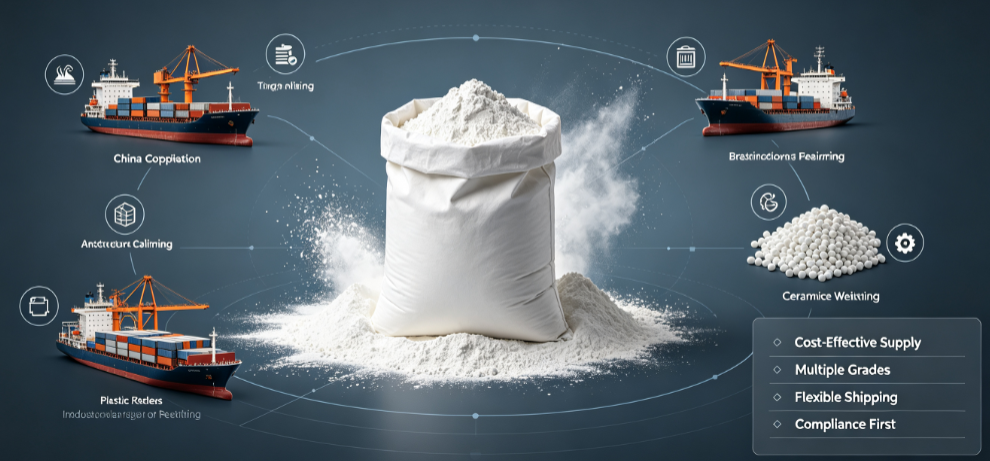
1. HS Code Classification for Titanium Dioxide
Correct HS code classification is the foundation of any smooth import process. For titanium dioxide, the primary HS code under the Harmonized System is:
|
HS Code |
Description |
Notes |
|
3206.11 |
Titanium dioxide-based pigments, containing ≥80% TiO₂ by weight | Covers all rutile and anatase pigment grades; most common classification |
|
3206.19 |
Other titanium dioxide-based pigments and preparations | For mixed TiO₂ products or masterbatch concentrates |
|
2823.00 |
Titanium oxides (non-pigmentary TiO₂) | For technical-grade TiO₂ used in ceramics, welding, etc. |
Country-Specific HS Code Variations
While the first six digits (3206.11) are harmonized globally, most countries add additional digits for tariff and statistical purposes. Below are the local codes for key target markets:
|
Market |
Local HS Code |
Base Import Duty |
FTA Available |
Duty Under FTA |
|
Vietnam |
3206.11.90 |
5% |
ACFTA (ASEAN–China) |
0% |
|
Thailand |
3206.11.00 |
5–10% |
ACFTA |
0% |
|
Indonesia |
3206.11.10 |
5–15% |
ACFTA |
0% (with CO) |
|
Turkey |
3206.11.00.00.00 |
6.5% |
N/A for China |
No FTA |
|
UAE |
3206.11.00 |
5% |
N/A for China |
No FTA |
ACFTA (ASEAN-China Free Trade Area) allows qualified TiO₂ imports from China to enter Vietnam, Thailand, and Indonesia at 0% duty, provided a valid Form E Certificate of Origin is issued. This can represent a cost saving of 5–15% per container — a significant advantage over non-FTA suppliers.
2. Import Duty and Tariff Planning
Duty Calculation
Import duties for TiO₂ are calculated on the CIF (Cost, Insurance, Freight) value. For example, an order valued at USD 25,000 CIF to Turkey at 6.5% duty would incur USD 1,625 in import duty. Additional charges to factor in:
- • VAT/GST: Typically 8–10% in ASEAN markets; 18–20% in Turkey and the UAE
- • Port handling fees: USD 200–500 per 20-ft container depending on the port
- • Customs clearance fees: USD 100–300 per shipment for licensed customs brokers
- • Storage/demurrage: USD 50–150 per day if containers are not cleared within free-time periods (typically 5–7 days)
3. Local Certification and Regulatory Requirements
Vietnam
Vietnam is one of the most accessible markets for Chinese TiO₂ imports. Key requirements:
- • Form E Certificate of Origin (for ACFTA 0% duty) — issued by China Chamber of Commerce
- • No mandatory pre-import registration for TiO₂ (it is not a controlled chemical in Vietnam)
- • Customs declaration via VNACCS/VCIS electronic system — broker assistance recommended
- • Testing: Customs may request random CoA verification; retain supplier CoA for each shipment
[Image: Map of major TiO₂ import routes from China to Southeast Asia, highlighting key ports and transit times]
Thailand
Thailand has a mature paint and plastics industry, importing substantial TiO₂ annually. Requirements:
- • Form E for ACFTA duty exemption — must be submitted within 30 days of customs clearance
- • FDA registration: Not required for TiO₂ as an industrial pigment, only for food-contact grades
- • Thai Industrial Standards Institute (TISI): Volatile organic compound (VOC) limits apply for paints but not for raw TiO₂ pigment itself
- • Labeling: Imported chemicals must have Thai-language labels indicating product name, manufacturer, and hazard information
[Image: Document checklist infographic for TiO₂ import clearance in ASEAN markets]
Indonesia
Indonesia has more stringent import procedures than Vietnam or Thailand:
- • Surveyor report (LSK): For shipments over USD 5,000 CIF, a pre-shipment survey by an appointed surveyor (e.g., SGS, BKI) at the Chinese port of loading is required
- • API (Angka Pengenal Importir) – Importer Identification Number: Required for all commercial importers. Companies must register with the Ministry of Trade
- • Post-border verification: Indonesian customs carries out post-clearance audits on TiO₂ imports, especially for Form E declarations. Keep complete documentation for 5 years
- • SNI certification: Currently optional for TiO₂ raw pigment. However, if TiO₂ is used in paint products sold in Indonesia, those finished goods must comply with SNI standards
[Image: Step-by-step flowchart of TiO₂ import clearance process for Indonesia, highlighting surveyor report and API registration requirements]
Turkey
Turkey is the largest TiO₂ import market in the Middle East region, driven by its strong paints and construction chemicals sector:
- • No FTA with China: Standard duty of 6.5% applies (MFN rate). No Form E benefit
- • KKDIK (Turkey REACH): Under Turkey’s REACH-like regulation (KKDIK), TiO₂ importers or their Only Representatives must register substances imported over 1 tonne/year. Registration deadline extensions may apply; check current status with a local consultant
- • CIF value declaration: Turkish customs closely scrutinizes declared values. Under-invoicing risks penalties and cargo detention
- • CE marking: Not required for TiO₂ as a raw material. However, finished paint products using TiO₂ may require CE if sold in Turkey’s EU-customs-union market
[Image: Turkey TiO₂ import process flowchart: customs clearance with KKDIK compliance steps]
UAE
The UAE serves as both a domestic market and a regional hub for TiO₂ re-exports to other Middle East and African markets:
- • Standard duty: 5% CIF, no FTA benefit for Chinese TiO₂
- • ESMA (Emirates Authority for Standardization): TiO₂ imports do not require ESMA certification as a raw material, but labeling must include UAE-specified hazard communication
- • Free Zone advantage: Importing TiO₂ into Jebel Ali Free Zone (JAFZA) or other free zones allows duty-free storage and repackaging, with duty paid only on quantities exiting into the local market. Ideal for regional distributors
- • Re-export: Thailand and Vietnam have both re-exported TiO₂ through Dubai to third markets (Iraq, Iran, East Africa). Ensure the Certificate of Origin supports re-export documentation
4. Logistics and Shipping Options
Sea Freight from China to Target Markets
TiO₂ is shipped as a dry bulk powder in 25 kg bags, 1–1.25 MT big bags, or in bulk container liners. The most efficient shipping method for most importers is a 20-ft container (fits approximately 18–20 MT of bagged TiO₂).
|
Destination |
Port of Loading (China) |
Port of Discharge |
Transit Time |
Est. Freight/20′ (USD) |
|
Vietnam |
Fangchenggang / Shenzhen |
Haiphong / Ho Chi Minh |
5–8 days |
$300–600 |
|
Thailand |
Fangchenggang / Shenzhen |
Laem Chabang / Bangkok |
7–10 days |
$400–700 |
|
Indonesia |
Fangchenggang / Shanghai |
Tanjung Priok / Surabaya |
10–14 days |
$600–1,000 |
|
Turkey |
Shanghai / Ningbo |
Istanbul (Ambarli / Kumport) |
22–28 days |
$1,200–2,000 |
|
UAE |
Shanghai / Shenzhen |
Jebel Ali (Dubai) |
14–18 days |
$800–1,300 |
Alternative Logistics Routes
For urgent orders or smaller volumes, consider these alternatives:
- • China-Europe Railway (via Kazakhstan, Iran to Turkey): Covers Xi’an to Istanbul in 18–22 days, faster than sea (22–28 days) and competitive on cost (USD 2,500–3,500/container). Ideal for high-value, time-sensitive orders to Turkey
- • Air freight: Practical only for samples (50–200 kg). Cost is prohibitive for bulk orders (USD 1.5–3.0/kg)
- • LCL (Less than Container Load): Consolidation services available from Shanghai and Shenzhen for buyers needing 5–15 MT only. Slightly higher per-ton cost but avoids waiting for a full container load
[Image: Logistics route map showing sea freight + China-Europe Railway options for TiO₂ from China to Southeast Asia, Turkey, and UAE]
5. Documentation Checklist
Every TiO₂ import shipment from China requires the following commercial documents. Missing any one of these can result in customs delays, fines, or cargo detention:
|
Document |
Purpose |
Issued By |
| Commercial Invoice | Declares value, quantity, HS code, and Incoterm for customs valuation | Supplier (freely issued) |
| Packing List | Details bag count, net/gross weight per pallet, container loading plan | Supplier |
| Bill of Lading (B/L) | Proof of shipment and title document; surrender for cargo release | Shipping line |
| Certificate of Analysis (CoA) | Evidence of product specifications matching the contract; required for customs random inspection | Supplier (factory lab) |
| Form E (Certificate of Origin) | Required for ACFTA 0% duty in ASEAN markets | China Chamber of Commerce |
| Insurance Certificate | Covers the CIF value during transit; required for CIF shipments | Insurer |
| Packing Declaration for Wood | Confirms wood pallets are ISPM-15 heat-treated or fumigated | Supplier (pallet supplier) |
6. Cost Comparison: Local vs. Imported TiO₂
One of the most common questions buyers ask is: “Is importing TiO₂ from China cheaper than buying locally or from a regional distributor?” The answer depends on volume and the specific market.
|
Market |
Chinese TiO₂ CIF Price (USD/MT) |
Local/Distributor Price (USD/MT) |
Savings Direct Import |
|
Vietnam |
$2,100–2,400 |
$2,400–2,700 |
10–15% |
|
Thailand |
$2,100–2,450 |
$2,450–2,800 |
10–18% |
|
Indonesia |
$2,150–2,500 |
$2,600–3,000 |
12–20% |
|
Turkey |
$2,200–2,550 |
$2,600–3,200* |
10–25% |
|
UAE |
$2,200–2,500 |
$2,600–3,100* |
12–25% |
*Prices for Turkey and UAE local/distributor include European (Chemours, Tronox) material which typically commands a premium. Chinese TiO₂ is competitive even at duty-inclusive pricing.
For buyers importing 100–500 MT annually, direct import from a Chinese manufacturer like SUN BANG typically saves 10–25% compared to purchasing through local distributors or agents. The savings increase with volume due to tiered pricing and consolidated shipping.
[Image: Cost comparison bar chart: Chinese TiO₂ CIF price vs. distributor/local price in Vietnam, Thailand, Indonesia, Turkey, and UAE]
7. Selecting a Chinese TiO₂ Supplier
Not all Chinese TiO₂ suppliers offer the same level of export service. When evaluating potential partners for Southeast Asia or Middle East market supply, verify these capabilities:
1. Export experience: How many years has the supplier actively exported to your region? Request references from current customers.
2. Production base location: Suppliers near southern ports (Fangchenggang, Shenzhen, Shanghai) offer shorter domestic logistics for ASEAN routes. Suppliers near Xi’an are better positioned for China-Europe Railway shipments to Turkey.
3. Grade consistency: Request CoA data from 3+ production batches. The D50, TiO₂ content, and oil abson should not vary more than ±–3% between batches.
4. Documentation reliability: Can the supplier issue Form E correctly? Have they handled surveyor inspections (for Indonesia)? Incomplete documentation causes the most import delays.
5.inimum Order Quantity: Ideal suppliers offer flexible MOQ — 1 MT for samples, 16–20 MT (full container) for commercial orders. Avoid suppliers that require 50+ MT initial orders.
Conclusion
Importing TiO₂ from China to Southeast Asia and the Middle East is a proven path to cost savings and supply security, provided the import process is handled correctly. The keys to success are: correct HS code classification with local variations, leveraging ACFTA preferential duty rates where applicable, understanding each market’s specific certification requirements, choosing the right shipping route for your timeline and budget, and working with a reliable Chinese supplier experienced in export documentation.
SUN BANG has been supplying TiO₂ to buyers in Vietnam, Thailand, Indonesia, Turkey, and the UAE for over a decade. Our exports team manages Form E documentation, surveyor inspections, and logistics coordination from our production bases in Kunming and Panzhihua to ports across Asia and the Middle East. Contact our international sales desk for a CIF quotation to your nearest port.
About the Author
[Author] Wang Leyang — Technical Application Specialist, SUN BANG TiO2
10+ years of hands-on experience in titanium dioxide technical application across coatings, plastics, rubber, and paper industries. Specializes in rutile and anatase TiO2 performance optimization, grade selection, and global compliance standards. Has supported procurement and technical teams across 20+ countries in selecting the right TiO2 products for their manufacturing processes.
LinkedIn: linkedin.com/company/zhongyuan-shengbang-xiamen-technology-co-ltd
Facebook: facebook.com/share/18Vsc4d4Wy
Post time: Aug-04-2026


